Proving communal warfare among hunter-gatherers: The quasi-rousseauan error

##Abstract

Was human fighting always there, as old as our species? Or is it a late cultural invention, emerging after the transition to agriculture and the rise of the state, which began, respectively, only around ten thousand and five thousand years ago? Viewed against the life span of our species, Homo sapiens, stretching back 150,000–200,000 years, let alone the roughly two million years of our genus Homo, this is the tip of the iceberg. We now have a temporal frame and plenty of empirical evidence for the “state of nature” that Thomas Hobbes and Jean-Jacque Rousseau discussed in the abstract and described in diametrically opposed terms. All human populations during the Pleistocene, until about 12,000 years ago, were hunter-gatherers, or foragers, of the simple, mobile sort that lacked accumulated resources. Studying such human populations that survived until recently or still survive in remote corners of the world, anthropology should have been uniquely positioned to answer the question of aboriginal human fighting or lack thereof. Yet access to, and the interpretation of, that information has been intrinsically problematic. The main problem has been the “contact paradox.” Prestate societies have no written records of their own. Therefore, documenting them requires contact with literate state societies that necessarily affects the former and potentially changes their behavior, including fighting.

##Conclusion: Hunter-Gatherers and the Human Potential for War and Peace
Quasi-Rousseauism, which has occupied center stage in the Rousseauan discourse since the turn of the twenty-first century, represents significant progress in the debate on the antiquity of human deadly fight-ing. Its proponents have accepted the documented evidence of very high rates of killing among hunter-gatherers, Raymond Kelly forth-rightly, Douglas Fry more obliquely.

evan21446.pdf (435.1 KB)
[Source - Full HTML]
1 Like

Another volley in the endless game. Thoughts on this entry by Azar Gat?

1 Like

Warfare is my area of expertise. Actually my proposed area of study for a Ph.D that I never was able to follow through on (try getting a Ph.D in cultural anthropology when you refuse to live in or near a city, doesn’t work out well).
Not having read the article, the abstract and conclusion seem to continue the old problem innate to this discussion (which Kelly, Fry and Ferguson all blew apart), that fighting is very different from warfare. One is organized and co-ordinated, the other not. But warfare requires a degree of separation and collective identity that doesn’t fit with an IR HG world where mobility is central and band composition is notably in constant flux.
I need to finish my goddamn book already.

1 Like

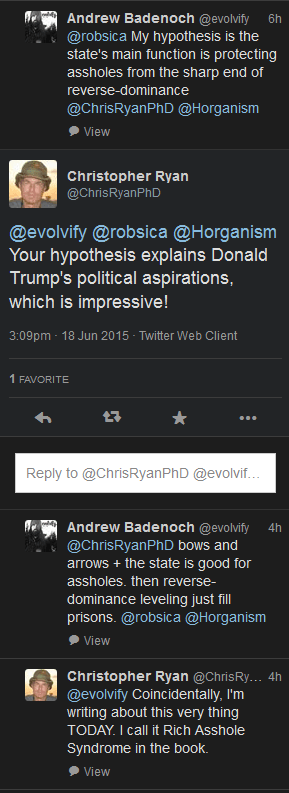
My hypothesis is that the main function of the state is to protect assholes from the sharp end of reverse-dominance leveling mechanisms.

  • In immediate-return non-state societies all/most violent deaths can be attributed to the practice of leveling (killing assholes), or

  • conflict with encroaching delayed-return neighbors (which is a subset of reverse-dominance defense, albeit often a failed attempt)

  • In non-state delayed-return societies, higher levels of death are seen as property defense is added on the reverse-dominance death toll (assholes killing assholes + reverse-dominance killing of assholes).

  • In state societies, assholes are protected, and reverse-dominance leveling fills prisons.

Pinker et al use the sleight of hand of counting IR run-ins with DR cultures (assholes) against the IR cultures. Then averaging out those composite numbers, non-state numbers appear very high. But the rub is that any lower violence numbers in state societies represents an increase in deaths of those who would act in reverse-dominance roles, and a decrease in the deaths of assholes.

Typing on a phone makes editing annoying. Does that make sense?

1 Like

It does make sense, but the DR advent of warfare kind of rules out the asshole aspect. Vayda’s ecological take on the role of warfare as a response to the conditions that arise through DR (namely sedentism) removes the ecological functionality of nomadic hunter-gatherer life.
In short, populations rise, mobility diminishes, artificial group cohesiveness is enhanced, and instead of acts of group healing (ie, the !Kia amongst the !Kung) are resolved by a warfare cycle that internalizes oppression from an outside group. If the assholes don’t exist, it was necessary to create them. Witchcraft and sorcery are to blame for the ecological and social pressures that sedentism entails. So the cycles of raiding and warfare are corrective measures and release valves for what would be a long-long-long term sense of instability.

But agreed on the other points.
The Huaorani have been a favorite case point of mine. They were, up through the “anthropological present” a warring nomadic hunter-gatherer society. They should be the example that breaks the rule, but their history is entrenched in battling off colonizers, first Andean, then Spanish, then Modernizers (famously missionaries, less famously oil prospectors). If you remove that cultural context, then yes, they were a warring IR HG society, but that’s not really the case at all.
Killing, in the case of IR HGs, is typically a matter of liability assessment. If you have no police and no external order you can fall back on and your problems are your own, if someone just loses it, then they can or may do more harm than good.

1 Like

I don’t follow. Are you saying there are no violent deaths among paleolithic HGs to account for?

I think that there are a few very old examples of HG violent deaths, and that those examples are likely among bands who went through an escalating series of social mechanisms (humor, ostracism, etc.), and when those failed, the person who was resistant to social pressure was simply an asshole (psychopath, sociopath, etc.). So this accounts for deaths in the archaeological record that may be, and are at every opportunity, explained as “warfare” by the Hobbesian crew.

1 Like

Definitely misreading that one, there are absolutely violent deaths amongst HGs past and present, but they do not constitute warfare. Organized violence is a specific type of violence.

1 Like

Agreed. You know that, and I know that, and Pinker probably knows that. Unfortunately, the Hobbesian narrative runs so deep in our culture that “nuh uh, Steve” doesn’t seem to win a lot of arguments. I think that, to whatever extent it even matters, having an alternative narrative would be helpful in giving people a reason to reject Pinker that’s more satisfying to their brain goop.

1 Like

Kelly and Ferguson did a great job on that narrative too, but Pinker misses it. Fry did an even better job since Beyond War is really written as a popular book.
Narrative battles are the worst.

1 Like

Doug Fry and Chris Ryan have a pretty candid discussion about Pinker’s apparently willful misrepresentation of the data in this interview:

Tangentially Speaking - Episode 101

Chris and I are apparently having a coincidental “competition” over this idea. From today:

1 Like

Thanks KT and Andrew for the posts here, I love this shit. Kevin really turned me on to the anthropology of war stuff years ago when I read ST4 and then began to consume as much anthro lit as I could.

A lot of this debate comes down to arguing definitions of war. I agree with the definition of my camp, obviously, but I’m curious to see how the OP article defines it, if it does?

Another aspect of this is an original egalitarian access to arms and tracking techniques, compared to the ability to use guns, germs, and steel against sustainable cultures, or to massacre at a distance. I’ve written 12 page rebuttals to Pinker, but really, we only need see that the world sits on the brink of total ruin, that the violence is intentionally organized and structured, and that even if they haven’t detonated the bomb, they’re sure as fuck trying to. I don’t think anyone can say in good conscience that the US Navy currently bombing the Arctic during war games at this moment is not displaying an act of violence so great that forager skirmishes pale in comparison.

Maybe Pinker was right. Oh yes, let’s embrace so eagerly the “less violent” world of civilization: chemical warfare, slave raiding, wars of extermination, nuclear warfare, biological warfare, ethnic cleansing and death camps, expansionistic genocide, prisons, factory farms, vivisection, police states, mass sexual assaults, mass extinctions, sex trafficking, apartheid, border battles, plantation slavery, industrial resource wars, wage slavery, military adventurism, drawdown-and-overshoot-induced famines and collapses, class oppression, extrajudicial government assassinations, racist lynchings, mass domestic violence, the creation of colonies and ghettos and slums and shantytowns, constant threats toward autonomy, and bullshit apologetics. Let’s embrace degenerative illness, malnutrition, cancer, car accidents, occupational hazard and death, nuclear meltdowns, oil spills, and the general toxicity upheld by the industrial capitalist State. If not the physical violence, let’s welcome the mental violence of high rates of depression, anxiety, suicide, loneliness, apathy, and other psychological afflictions of modernity. After all, it’s the best, and the only, way of life, right?

3 Likes

Clastres beat you both to the punch.

1 Like

Has anyone tried the download link? I haven’t tested PDF downloads in the forums. Though uploading worked.

1 Like

Foreshadowed by Ferguson,[51] the Quasi-Rousseauan position has been the most distinctive in the recent Rousseauan literature. In his Warless Societies and the Origin of War, Raymond Kelly, explicitly breaking with the Classical Rousseauan tradition, fully accepts that, as the ethnographic record shows, hunter-gatherers experienced exceedingly high rates of killings, far higher than those common among modern state societies.[76] At the same time, analyzing the evidence, Kelly argues that the less organized, less clustered around clan and tribe, and less segmented a hunter-gatherer community was, the less it experienced collective, intergroup “warfare,” as distinguished from homicide and feuds that did not involve or target the entire community on either side. Kelly’s analysis suggests that the absence of segmentism largely correlates with, among other things, the low population density of mobile hunter-gatherers. Since our Paleolithic ancestors were overwhelmingly sparse and mobile hunter-gatherers, Kelly concludes that although homicide and feuds were probably rife among them, warfare as such seems to have developed only after that time. More or less the same view has been adopted by Douglas Fry.[77, 78] Unlike Kelly, who straightforwardly embraces the statistics of violent death recorded among recent hunter-gatherers, Fry avoids specific mention of the evidence that killing rates among them were, on average, very high. Nonetheless, he tacitly accepts this, while claiming that they fell under the categories of homicide and feud rather than warfare.

The distinctions between homicide, feud, and warfare involve both semantic and substantive questions. Note that the framing of aboriginal human violence by Kelly and Fry is very different from either Hobbes’s or Rousseau’s. Hobbes’s “warre” encompasses all forms of deadly human violence, including homicide and feuds, which made the human “state of nature” so insecure and lethal. Similarly, Rousseau’s peaceful aboriginal condition, presupposing minimal human sociability and interaction, was ostensibly free from all forms of human violence. Thus, both Hobbes’s and Rousseau’s understanding of belligerence and peacefulness are very close to that used in anthropological surveys and statistics of aboriginal deadly human violence[79, 80] which Kelly and Fry criticize for conceptual fuzziness. This is why this article refers to claims such as those made by Kelly and Fry as Quasi-Rousseauism. These claims sound very significant with respect to aboriginal human violence. However, they actually hang on a thin thread of definitions for which the empirical basis, as we shall see, is very dubious, cf.[81] while turning the spotlight away from the question of hunter-gatherers’ violent mortality rates. These rates are the fundamental question in the debate regarding the aboriginal human condition, whether it was violent or not. The centuries-old debate appears to have been discarded at a stroke, without anybody admitting or even realizing it.

1 Like

Download works and this article is absolute garbage.
He doesn’t distinguish warfare and violence in his attempts to refute Ferguson, Fry and Kelly, while grasping onto Keeley with vigor. It’s just “Rousseau was wrong, so Hobbes is right”. His example of HG warfare is amongst Aborigines, so there’s no IR/DR concept invoked here.
Useless and just attempting to be incendiary.

Edit: Andrew posted the relevant section.

1 Like

I love this topic. Read almost all the pdf. But I can’t still get why there’s no mention of the possible causes of those ancients deaths. He concludes violence is not one of our primordial needs, but it would be interesting to know wich one (of not all) of those would unleash lethal violence if threatened. And if in anycase that ‘peace’ is just a tense equilibrium between uncontainable impulses and survival, or an unspoken agreement between parties. My poorly educated guess is that Russeau’s society is not a stable state for groups, while Hobbe’s is. But I’m no anthropologist.

Besides, I’d love to hear some hyphotesis of how an IR group becomes a DR group. That really bugs me, what could have made a group change IR for DR in the first place. My guess is fictious thought. IR could become DR when the IR is present in our imagination and some time later, in reality. So DR groups would have started as ‘virtual’ IR groups. Perhaps the first glimpse of ‘hope’.

And if anyone knows, if theres an article describing how fictious thought enabled DR in homo sapiens, and how this became a decisive advantage for outweighing all non DR species (inlcuding humans)? And now we’re on the top of the food chain but stuck with all DR consequences (state, religion, work, money, etc).

1 Like

Hunter-gatherer ways of living together socially (in largely egalitarian structures incompatible with Hobbes) seem to have been stable for 2,000,000+ years. Over this time, human evolution reflects what we would expect in an egalitarian society moving toward a flat social structure and away from dominance roles.

One example of this is the shrinkage, and near disappearance, of “canine” teeth. Among primates, these aren’t typically used for carnivory so much as displays and conspecific aggression

Another clue is the reduction in body size between male and female humans. The difference had narrowed to around 15% in the Upper Paleolithic, and remains in that range now. Species with high levels of dominance tend to have significantly higher levels of sexual dimorphism.

And I think this is an important point. Going back toward our common primate ancestors, 6.5 MYA or so, we do see higher levels of dimorphism and larger canines. As hominin began to walk bipedally and grow bigger brains, these differences evolved toward traits expected in less violent egalitarian species.

There is basically zero support for high levels of species-wide violence in the paleolithic. Others (especially Doug Fry) have given all sorts of reasons for deaths and injuries that have nothing to do with violence. One that’s seldom talked about is hunting accidents. Less accurate weapons combined with much higher time spent hunting than current humans alone has the potential to take enough of the data points out of the “violence” column to make dissolve the whole argument.

I really would highly recommend listening to the Chris Ryan interview of Doug Fry for perspective.

1 Like

Another way to interpret this article’s conclusions would be to go with it, in a sense, and use it as proof against the idea that the utopian “noble savage” position even exists anywhere but the minds of those invoking it as a strawman. This article proves, if nothing else, that anthropologists have incorporated new data into their theories and hypotheses. If that’s true, and I think that it is, it undermines the Hobessians’ position that anthropologists are just a bunch of starry-eyed zealots resistant to all evidence.

1 Like

Is there a correlation between violence and human population density? E. g.: two or more HG groups competing for the same resources?

1 Like

Absolutely, but the fine print is that human population density issues are linked largely to sedentism. So the IR/DR principle comes back into play. This is one reason why warfare was seemingly non-existent amongst hunter-gatherers: sheer mobility. It strengthens lateral bonds, renders xenophobia impossible, and centers around an ecological principle of flux and movement.
The beauty of the IR HG life-way is more in its overall function than in canonizing its tenants.

1 Like