Node One: Communications Analysis

There’s maybe one neighbor in a 5 mile radius so the idea to spread costs around doesn’t have much leverage. Not saying I won’t have a chat with the ole codger, but it’s not like there’s a village to shop the idea to.

But we’re talking about 2 different things, the WAN (internet) link and the LAN (local). It’s possible to set up an elaborate system of repeaters to coax WiFi over hill and dale for the WAN, but why bother when there’s 4G LTE much closer? While hopping and skipping and jumping WiFi appeals to the tinkerer in me, it seems unnecessarily complex.

Knowing there’s fast internet at point A, which is only 2 miles away, why not use that for the WAN interface and use WiFi for the LAN? And if WiFi is used for the LAN, which ubiquity product(s) make the most sense?
The only neighbor has the aforementioned satellite system, and is not amenable to sharing that connection due to its low data cap.

So to wrap real numbers around it, if there’s a way to get faster internet to the one neighbor, there’s a potential for $60-$90 in gross monthly revenue if one is willing to accept the headaches if becoming an ISP.

But really, the ISP angle won’t work because powering the system in winter for 24-7 internet would require a remote generator, and that doesn’t even pencil.

It’s not going to be cheap when all things considered no matter which route you go. The equipment from UBNT is rather affordable for what it does (their 100km 1+GB/s antenna/dish is less than $1,000) but at the end of the day the actual internet and power needed to run the equipment is ongoing. And being so far north does have the disadvantage you mentioned of not being able to rely on solar.

As per our earlier discussions about the project needing to be a somewhat profitable business enterprise at the start, these issues are the reason why. Some modern creature comforts that require $ would need to be established to make smooth transitions into the community and then can be gradually phased out over time. 99.999% of the population would be unable to mentally handle the transition from the life they have now into a 100% paleo/wild lifestyle. If we were better at handling change, then everyone that lost their job in 2008 would have applied for Chinese citizenship and worked at FoxConn.

Sadly, having RELIABLE internet in such a remote (and seasonally harsh) landscape will never be cheap or it would already be there. Remember, you can have your choice of price, quality, and speed…but only two at a time. And I think in some cases, internet in remote Alaska may be only choose one! That generator and it’s fuel would kill your budget unless wind power was reliable in the winter and you had a decent battery bank (which will also cost a pretty penny).

I’m pretty sure it will work fine as outlined in the original post for our purposes. The reliability/uptime thing is only a concern if trying to resell a service to someone who already has 24-7 internet.

Those tp-link antennas are being used irl for 11+ mile point-to-point links and we only have to go 2. So I’m looking at a $369 build + misc. connectors. Seems reasonable.

That’s not too bad. I paid a little under $500 for an entire kit that had the Bullet Titanium M2, 50ft outdoor cable, antenna, wifi/lan router, and various connectors, power adapters, PoE module, etc. All plug-and-play configured to work out of the box. All I had to do was log into the portal installed on the router via IP address on my laptop, choose a wifi signal (either open or password protected) and it connects. Then at that point all the devices on the boat just connect to that router and when the boat goes somewhere else, we just log in a choose a new wifi signal. It’s pretty simple and foolproof.

This is the one I bought for my boat. But on land I would probably try to use a directional antenna since (hopefully) you won’t be rocking back and forth and bobbing up and down.
http://shop.pdqconnect.com/collections/marine-wifi-products/products/allpro-hotspot-sailboat-kit?variant=1146432628

Cool. Yeah, that’s conceptually what I need at point B, but I have all of those bits except the antenna so I’ll just repurpose them. In effect, this system has to do what you’re doing on your boat + whatever magical WiFi/internet you connect to at a distance.

I’ll just throw this out there to see if anyone has experience with it: What are the chances a 5ghz point-to-point connection will work at this range without boosting the power, and with some tree cover at point B? I ask because the equipment is roughly the same price, has higher bandwidth, and most importantly, the antennas are about 40% smaller in that band. That would help a lot in terms of transporting equipment (by canoe!) and keeping it stealthy (since the relay will be on ppublic land). 5ghz is not the best range/power-wise, but it’s not a very long link.

Trees (or anything for that matter) in the way will result in lots of packet loss, especially if your antennas have to be pointed right at each other (will vary based on model and type). Especially so if the wind is fluttering them about. Need to keep them trimmed back or go over them. Having a clear line of sight will make a huge difference.

Pretty cool looking setup here:
http://samy.pl/proxygambit/

We have ordered the radios and antennas for OPTION 2, the 3/4G WiFi relay. We are raising funds for the equipment to power the station. We have $155 to go (as of July 21, 2015). Contributions can be made via PayPal to [email protected]

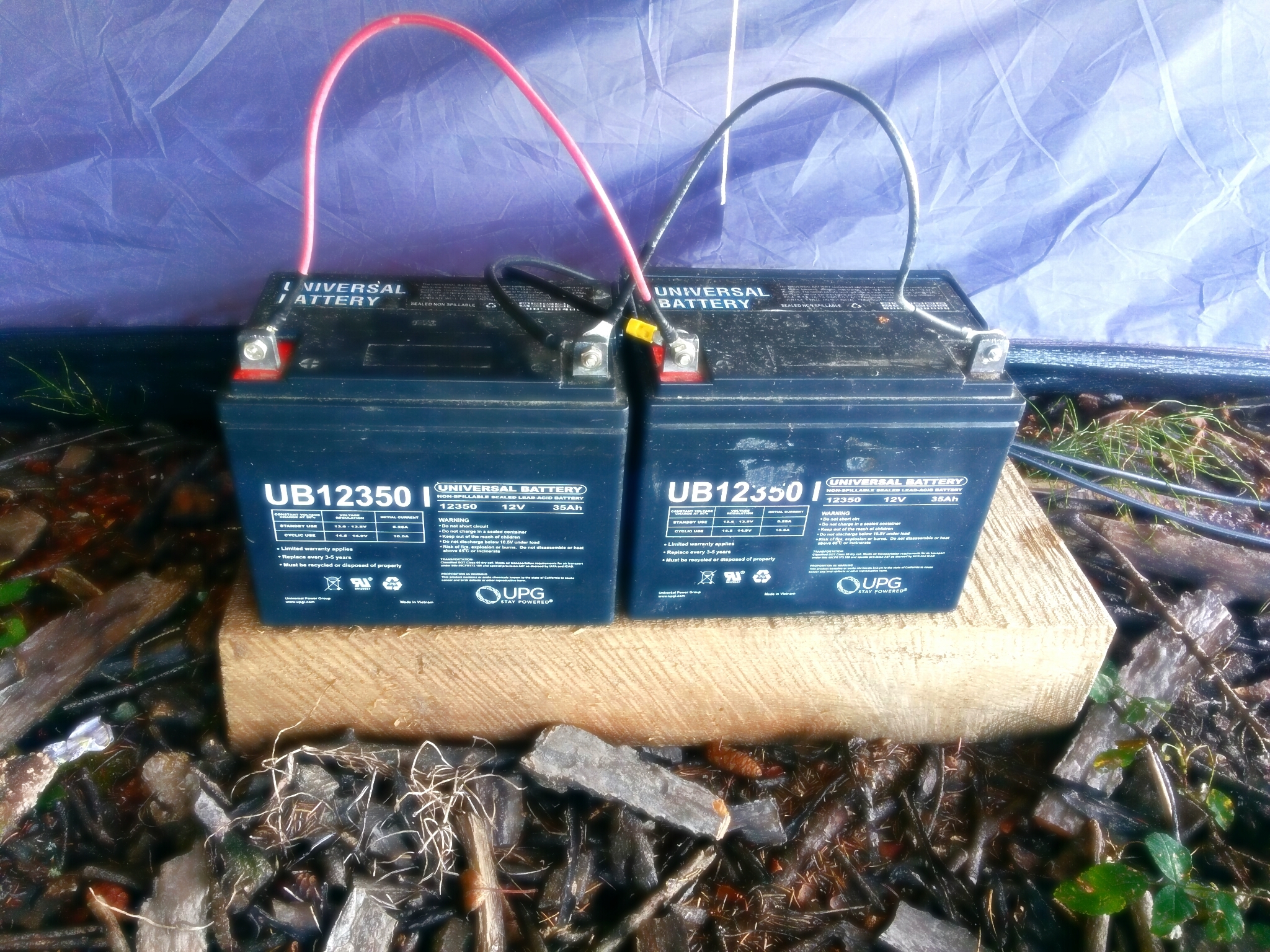
Basically, we are looking to order a copy of what we already have at the base station, but a little simpler (only 1 battery).

$55 to go!

1 Like

The system is officially ordered. We’re still $28 shy of our fundraising goal, but robbed the web hosting budget to get things rolling

Still accepting donations!

1 Like

After procuring all of the equipment listed in this thread, it turned out that my initial site analysis had problems. After getting to the land in fall 2015, none of the 7 devices I tested were able to get 2G/3G/4G. So I was stuck at the property with only the ability to bring in super slow 1G cell data. Generally speaking, it took 10-15 minutes for text-only emails to start downloading.

I’m now in Fairbanks, and have scheduled take the HughesNet satellite installer certification tomorrow, and dragging that equipment back to the land next week. Hopefully we’ll be online more regularly shortly after that.

1 Like

Now broadcasting low-speed, high-latency propaganda from a squatted cabin in some boreal forest.

3 Likes

Hey so which system are you currently using?
You tried the 3/4g Wi-Fi relay but the didn’t prove successfully?

Did u end up getting satellite?

I’m trying to do something similar in an area where the nearest (poor quality) cell signal is about 12 miles away.

There is a closer neighbour with satelite internet hookup. But line of sight to that is near impossible

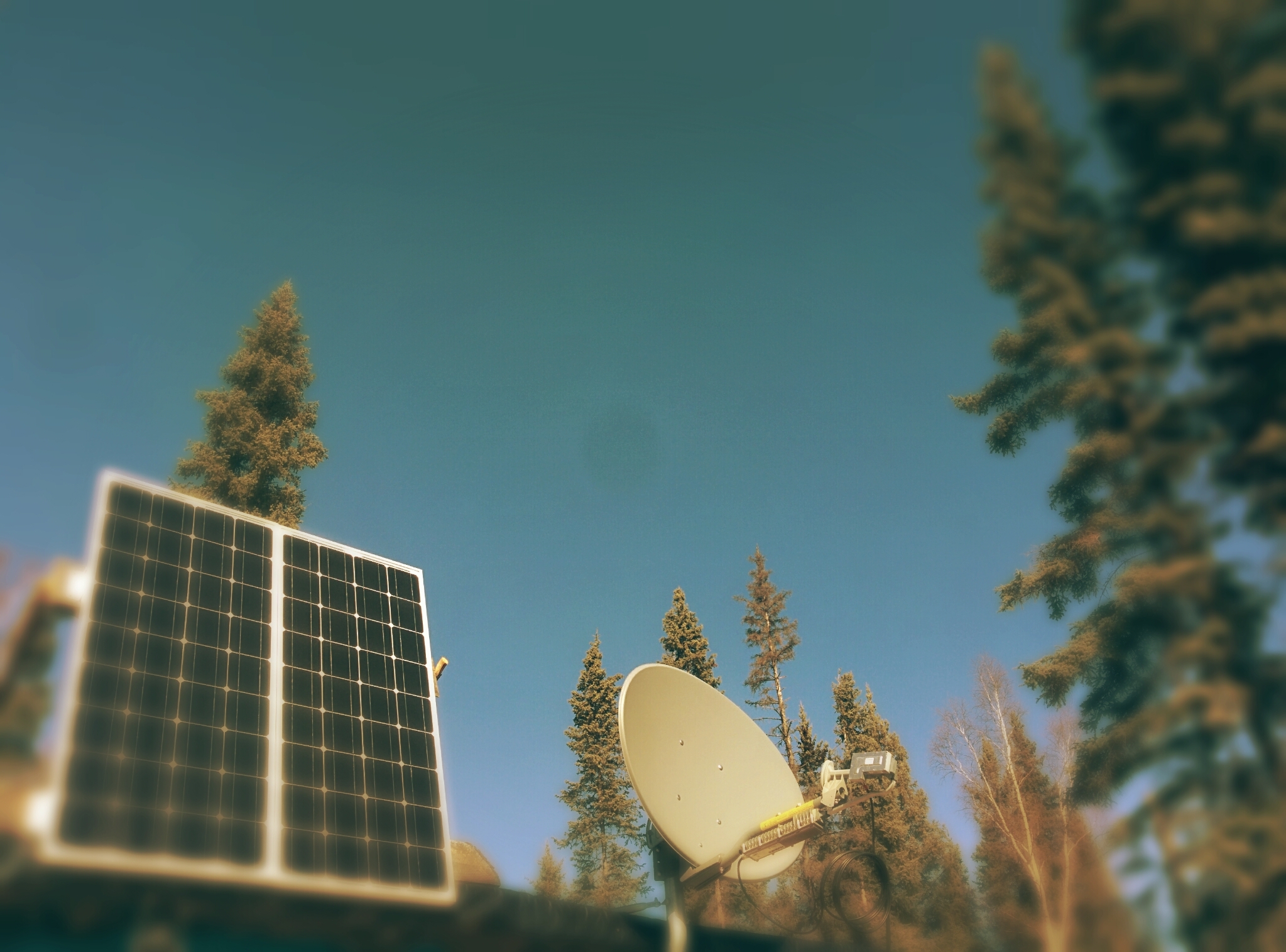
Yes, the satellite system pictured above is our current HughesNet setup.

The 3/4G reception for us was pretty much zero, but we’re something like 32 miles from the tower.

1 Like

You said Exede Internet was a no-go. May I ask why?

We’re “outside the beam” for Exede. Their satellites provide coverage a couple hundred miles west of us. It’s technically possible to eke out a weak signal with a 6’ dish, but it’s difficult to transport something of that size out here. Additionally, those dishes are not part of the normal setup, and cost quite a bit extra. HughesNet Gen4 is supposed to be online up here officially in the next several months, so that may provide an easier upgrade path.

Oh, also, the transmit power on our current dish is 1W, and pulling in and transmitting out of the beam requires at least doubling the power consumption, which would require us to upgrade our electrical infrastructure. Again, technically possible, but the budget increases quickly.