
I found this link to Alaska Native clothing from the Smithsonian. May provide some inspiration.
I don’t know if salmon is really the ideal skin for shoes. The sockeye I was helping my friend bark tan were pretty thin. Maybe Kings and Chums are thicker skinned? I could see kings being a possibility.
We only have 3 of 5 salmon species in the interior: king, chum, and coho/silver. Parts of Yup’ik territories have all 5, and in the book linked in the other thread, the elders specify king and chum, and not the other 3.
That doesn’t necessarily make them ideal, but being able to pull 300+ chum from the river in a day (with a fish wheel) is a different risk profile than maybe or maybe not getting a moose.
With any tanning you need a fat source too. That rancid beef tallow you have is not best but will work. The big Cascadian oil source was Thaleichthys pacificus (Candlefish/Smelt). Boiling hooves of ungulates will provide some neetsfoot oil. Rancid bear fat is the best.
On the topic of toboggans and canvas
I’m currently of the mind that a birch toboggan with a canvas tank custom fitted for securing gear is the way to go.
Yo @david, you listening? Have pictures of yours?
Here’s roughly what I’m referring to, note the white canvas running the length:
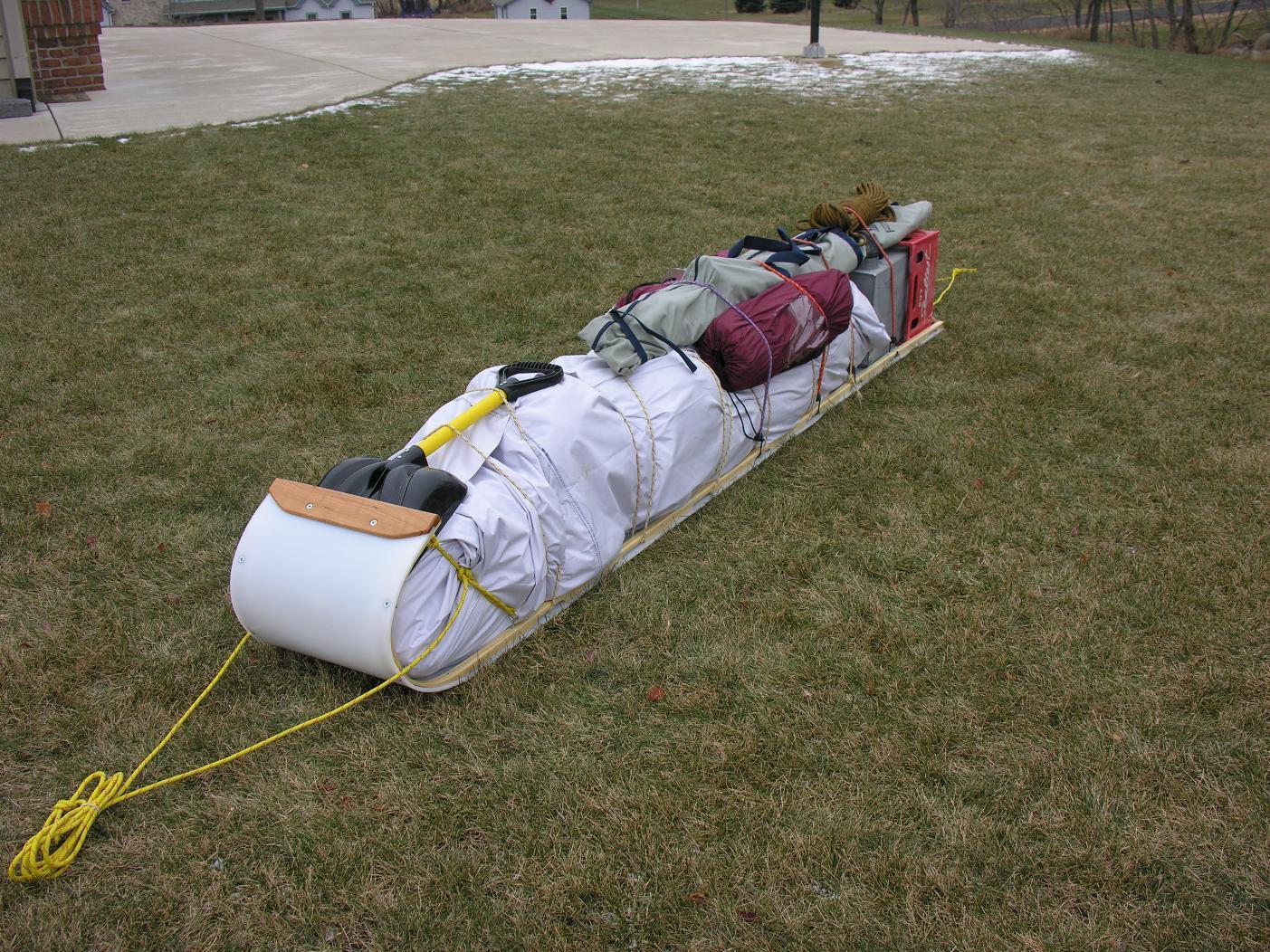
Source of image
My plan is to then make custom canvas duffels made to the sled’s width that fit inside the tank in a modular fashion. I am debating (with myself) whether to use oil cloth for the duffels, so they may be used as semi-dry bags in the canoe also.
Just wanted to throw that out there for purposes of any potential canvas orders.
Ventile Tent
Here’s a website selling EtaProof L34 DWR Impregnation 5.6 oz cotton tents. EtaProof is essentially Ventile. Not cheap at all. $1420-$1920 CDN.
Yeah, not cheap. I’ve seen places selling regular duck canvas wall tents in that price range too somehow. Did you see the Ventile thread I started?
@andrew I saw that thread. Ventile is way too expensive for me right now. In my research, I’m trying to exhaust all cheaper options before I go with something so pricey. I’m seeing recommended (by folks on snowtrekker.com forums, like Kevin Kinney of Empire Canvas Works) materials for $5-$6/yard. If I need around 12 yards (just guessing) that’s $60-$72 just for the fabric, which equals almost what I’d likely pay just for shipping for Ventile.
Kevin Kinney recommends and uses Pillow Ticking so now I’m looking into that. Pillow Ticking is what down pillows are made out of and is a very tight cotton weave to keep the down from sneaking through. It’s also $5-$7 a yard and available everywhere. In Snow Walker’s Companion, and elsewhere, recommends people use egyptian cotton sheets. Everyone makes clear that it’s not the same as real egyptian cotton, but people use it anyway.
Right now I’m debating between the Fairfield canvas and pillow ticking. And I’m thinking pillow ticking for an anorak. My only concern with pillow ticking, beyond whether pillow ticking will just rip to shreds, is whether I can make it mildew and fire resistant. I’ve seen too many moldy tents to not do something before hand.
Yeah. I brought up Ventile in the specific context of what’s the best overall, and agree that it’s real expensive. I can’t afford it right now either, but I am considering making a special effort to get some later.
David and Jeff are two of the more experienced people you’ll find, and they got the Fairfield stuff. Maybe there’s better stuff out there, but that’s what they got, and I’ve touched it, and they believe it’s good for the task at hand.
The climate such that it is here, I suspect mildew can be avoided by drying thoroughly before storage. That said, the chemicals probably saved me a lot of grief when I had to leave camp after sticking an axe in my foot. It was below freezing when I left and the tent was packed with ice on it from when we moved it last, and nobody was around to dry it out for a few weeks of damp spring weather. That was a case of accident (user error), and having my mistake softened by chemicals.
I know canvas can catch fire, and that can be super dangerous. I believe that Snow Walker’s Companion says or implies they don’t use fire-treated fabric, and the consensus vibe I get here is that Alaska Tent & Tarp has adopted their “no stove jacks without fire-treated fabric” out of liability concern, and doesn’t necessarily reflect the optimal point on the risk-reward scale of utility. The cheap dome tent I happen to be in right now has a huge fire warning tag because of liability issues too. I’m not saying it’s not a real concern, but it does seem to me that people with more experience than I have are against using fire-treated canvas.
BTW, I think I have 10-20 yds. Of 10 oz. of the robust duck mildew/fire treated stuff up here that I may not have a use for. That doesn’t help you in America today, but it reminds me that someone has mentioned maybe using fire-retardant canvas on panels closest to the stove jack in a targeted manner.
Actually the hok bindings gave us blisters with mukluks… A very poor design in many ways.
Fire retardant is pretty damn toxic stuff. Putting your stove jack out the side wall or end wall and extending the pipe out a ways will keep your fabric safe. So long as it is on the downwind side of the tent.
The main reason that snowshoes are an advantage to skiis is that they provide a wider trail “float” for a tobbagon or sled to move through. The webbing sheds the snow with each step while skiis will collect a lot of weight that way. Skiis without skins are too slippery to pull a heavy sled very well, though skins or cordage can be used to add traction… I love skiing and we usually bring a pair on our trips, but for all terrain travel without a trail, snowshoes are better in my opinion. Unless you have reindeer to pull or carry your kit
1 Like
David, do you use something to keep mold away [in canvas tents]? Do people just use a borax soak?
No. I use a poly Tarp as a fly and never fold it up damp. Its not too wet here anyway. Wood smoke?
I’m stressing some on looking at tent options. I see mentions of various materials being suggested which I wouldn’t expect to work well at all. I’ve lived in a canvas tipi and spent a fair bit of time in several canvas tents. I don’t see pillow ticking or other very light (natural)materials blocking wind with much effectiveness or withstanding much use. I’d like to be wrong, given the much greater weight of the material (10 oz. cotton duck canvas) I’m used to.
Consider 7 oz canvas from Fairfield textiles. And go to sites like the winter trekker.com forums. They can give you some helpful advice from experienced winter campers that will back up the Fairfield canvas and other helpful advice.
The Fairfield stuff seem to all be tincloth/oilskin. After reading 100+ threads on winter trekker and doing some other poking around I think I’ll pre shrink a couple of painter’s drop tarps and see what I can do with that before going any further.
Look at Fairfield Textiles “Commercial Dyed Pure Finish” 7oz. It’s $2.83 /yd. That may compete with the price of drop cloths.
I’ll check that. I think I’ll need to get sample books, different places seem to have pretty big differences between things that ought to be the same.
Fairfield textiles 6.25 oz untreated canvas
1 Like
“Natural”