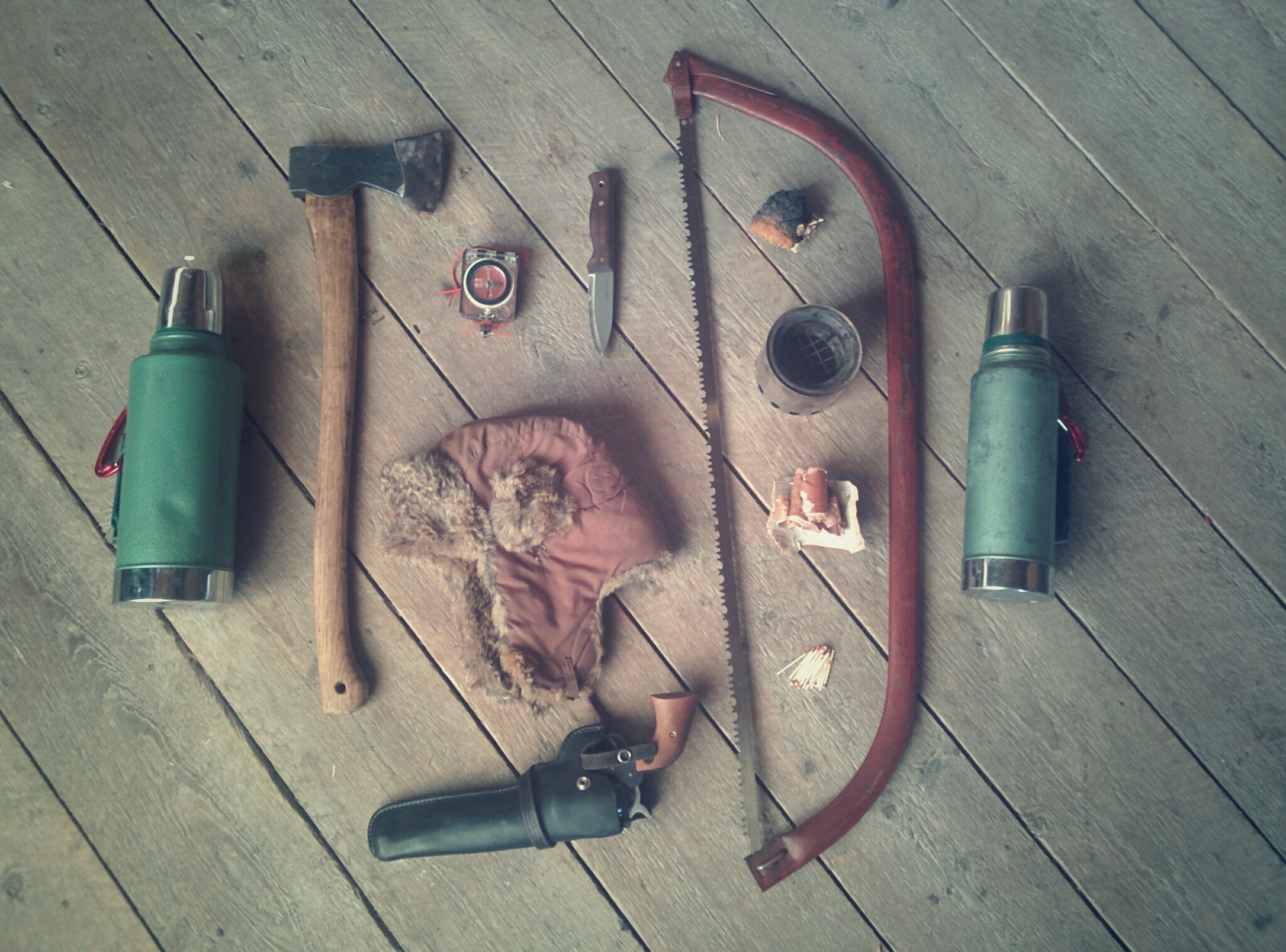
This list is an attempt to compile a minimum gear list for those intending to visit us for months+. If you are planning to come for an extended stay, please also take a look at the list of community gear we need at camp.
Continuing the discussions from:
This is a list of things that are more or less required over the course of a year. Some of the items are seasonal, and you don’t need to bring everything the first day. For instance, if you are arriving in June, it is not necessary to bring a sled and thermos for hot beverages.
##Clothing
Jacket, parka, anorak, shell, etc. There are a variety of strategies that would work here. A common modern-ish boreal strategy is to have a very oversized lightweight cotton canvas anorak that can accommodate several layers under it. The anorak is primarily for winter use. Ideally, it would be made at camp, and would initially require only the canvas/thread. In the long-term, a fur ruff would be added for warmth. In addition to this, some kind of “waterproof breathable” shell for non-frozen seasons. This shell doesn’t have to be the most fancy Gore-Tex stuff available, and could be a “hard shell” or “soft shell”.
- DIY cotton canvas anorak. (patterns for one option in Snow Walker’s Companion)
- Hooded soft shell. Example: Columbia Hooded Soft Shell ($50)
- Hooded hard shell. Example: Mountain Hardwear Men’s Plasmic Ion ($120). We have two of these in camp (as of 2016), but in older versions. They are fine above freezing, thought they are never as breathable as advertised. They are not great for winter use, as ice tends to develop on the inside.
Base layers (2 pair, maybe light and med)
Mud boots - Muck, Bogs, Xtra Tuf
Mukluks (Steger Arctic, 3+ sizes above your regular size recommended)
Life vest (ones that allow freedom of movement are extra nice)
Wool Socks (5 pairs that fit, 2 pairs next size up, 2 pairs two sizes up)
Headlamp
2 pair Thermafit gloves for picking nets
2 pair Atlas orange gloves with wool liner gloves for cold weather fish cutting as well as bacteria rich hide work
Fishing pants and jacket
Head net
Warm hat
Warm Gloves
Mitten shell and liners
Boot liners
Wool Sweaters and flannels for layering
Warm pants
Work pants
Long sleeve lightweight loose fitting shirts (tighter weave preferable)
Shell
Balaclava
Goggles (polarized)
Scarf/buff
##Tools
Axe (typically, “small forest” or “forest” size)
- Gransfors Bruks, small forest axe. Everyone seems to love these. ($160+)
- Husqvarna forest axe. These used to be great for the price. After changing manufacturers they are now good for the price ($70).
- Cheap and dirty: buy an axe head or broken axe at a garage sale ($5+) or eBay, then put on a new hickory handle (available at hardware stores for about $12). Or, find a small tree/branch that looks like an axe handle and use your knife to make it look more like a handle (free).
- Inexpensive but fine: Council Tool “Boy’s Axe” or “Hudson Bay Axe” $25-$40
- Other Higher-End: Wetterlings, etc.
Knife
- Condor Bushlore ($35)
- Morakniv ($15)
- Russell Green River
Puck Sharpener (works for knives, axes, draw knife, etc.) - Lansky Dual grit ($7)
##Kitchen
Bowl. Or slightly curved plate. Something to eat food off of and/or out of. We don’t keep a full set of china at camp.
Spoon. After having broken many sporks, Andrew recommends this one (the same thing can be found for like $.79 in other brands from other places). This doesn’t have to be a “spoon” per se, just be aware that we don’t usually have extra utensils around. They can be made from on-site materials with simple wood carving tools.
Cup. We tend to use 24 oz. mason jars. So maybe bring more of those, or something else, or DIY one. We do not recommend the blue/red enameled stuff with the white flecks. The coating seems to flake of with very light use.
Water bottle. Stainless-steel. 20-32 oz. Wide-mouth recommended.
2 Vaccum bottle, aka “thermos”. 32 and/or 64 oz. Wide-mouth convenient, but not necessary. We use vintage U.S. made Alladin-Stanley bottles. Since the company was sold, some of of the new manufacturing runs have had quality problems.
##Food Type Things
Fat
- Coconut oil
- Olive oil
- Butter
Emergency / Staples (Ask us)
-
Oatmeal
-
Rice
-
Beans
-
Lentils
-
Coffee, Tea
##Transportation
Sled. You’ll need some kind of sled/toboggan, but you should probably ask us for specifics. We are working on transitioning away from plastic sleds in favor of DIY birch toboggans.
- Paris Sno Hauler ($100)
- Siglin Pulk $200+
Snowshoes 4’-6’ long
300-1000 ft paracord. We recommend subtle/earth tones. Brightly colored paracord gets ugly after being covered in mud or blood.
##Shelter [Optional]
Likely helpful, but not always necessary. If you have these things, you may want to bring them. If not, it may not be necessary to spend additional money on them
Sleeping Pad Thermarest, foam, caribou hide, etc.
1 winter (-20–40)+ 1 summer (0-+20) sleeping bags
Bug net
Tent or tarp set up.
Backpack
Compass/navigation
Water filtration
Fire set up
Personal first aid
Small personal cook set up
###Unsorted
Bear spray. Unless you are driving, purchase in Fairbanks. Bear spray is prohibited on flights and by most shipping carriers.
Bug spray.
Bow saw blades. 36" raker blades.
36” bucksaw (buy the blade $10, [make the handle for free][1])
Ice chisel
Draw knife
Menstrual cup/sea sponges