
Continued from Section 2 of “The Commodification of Wildness and its Consequences”: The Roots of Commodification:
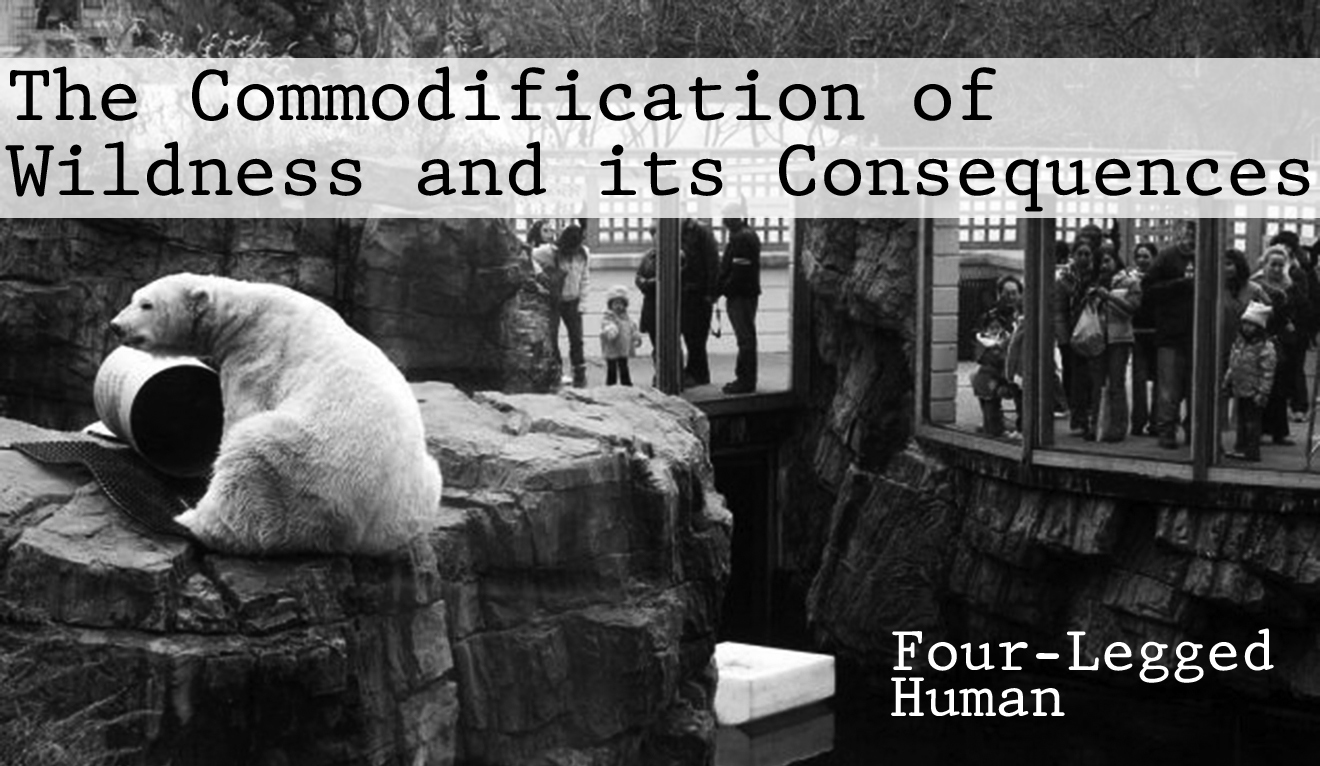
“The commodification of wildness is the beginning and the end of civilization”.
Kevin Tucker
Indigenous Native America is riddled with examples of social and ecological devastation occurring as a result of resource harvest patterns shifting from subsistence orientations to trade orientations, in both the colonial and pre-colonial contexts. Not too long after the Plains Indian bison hunting cultures obtained horses through the Spaniards, countless Great Plains bison were killed for the purposes of trading their tongues and their hides for European goods. Plains Indians simultaneously became dependent upon equestrian domestication and dependent upon trade for European goods, rifles becoming a particularly desired commodity. Inter- and intra-tribal conflicts increased as a result. Warfare and raids became more numerous as equestrians were able to cover vast areas in competition for resources and control of territory. Violence increased dramatically as native peoples experienced the surge of mass commodification moving west.
Fur trapping is another important example of the heavy impacts to traditional social relations and traditional approaches to economics initiated by commodification. During the eighteenth century when Russian traders invaded the Aleutian Islands off the Alaska Peninsula, the Aleut people were forced into sea otter hunting on a massive scale for the Russian fur trade. The Aluets were expert sea otter hunters and had used sea otters for fur and food for centuries prior to the Russian arrival. Skilled as the Aleuts were, the Russians forced them into servitude in sea otter pelt production by holding their wives and children hostage, raping the women regardless, and threatening to kill them if the men did not produce enough fur. As a result of their settled, delayed return orientation the Northwest Coast tribes maintained strong traditions of warfare, slave raiding, head hunting, and ritualized violence well prior to conquest. Nonetheless, involvement in the colonial fur trade seems to have greatly exacerbated such practices by these groups. According to anthropologist Joan Lovisek:
Slaves were always important to Northwest Coast cultures prior to and after contact, but the economic importance of slaves escalated after 1830, as warfare changed to opportunistic, individualistic predatory raiding. Slaves were ransomed for trade goods or sold to other groups for furs, which could then be exchanged for trade goods. For many groups…it was easier to obtain trade goods by predatory raiding than by trading, trapping, or hunting animals for furs.
When Euro-American authorities began to round up the remaining free Indians and confine them to reservations part of the deal for the surrender of their hunting grounds was a guarantee to an allocation of “commodities” by the US government, industrial food products to replace the wild foods that, without access to land, would no longer be available to Indians. Today “commodities” are still distributed by the BIA to Native Americans in Indian country. Indians mention commodity foods with ire and disgust, because of the debilitating health effects of these foods and because of the history of forced dependence on them for survival.
Just prior to the formation of Indian reservations, as Native American self-sufficiency was being annihilated by the effects of colonization and increasing numbers of Indians were becoming dependent upon European industrial goods, those who gave up on resistance were referred to as “loaf about the forts” by the bands who continued to hunt and gatherer for their food while simultaneously waging an armed resistance against the US military. The “loaf about the forts” were those Indians who stopped hunting and resisting and surrendered themselves as dependents to Uncle Sam and thus spent their days groveling about the Cavalry forts in search of commodity hand-outs. These re but few examples of the circumstances which led to a near total dependence on world-system industrial goods now defining the economies of all of the remaining northern Native American peoples.
We know that many pre-colonial indigenous peoples fully embraced delayed return and commodification, with hierarchy, property ownership, territorial warfaring, and slavery as the corollary. The maintenance of trading alliances likely made some groups more secure from outside threats and more resilient in the face of scarcity and/or ecological change, by providing a safety net to fall back on for obtaining an actually necessary good in the case of an inability to obtain that good independently. However, here we start walking on shaky ground because the differences between psychological wants and actual needs end up falling into very murky cultural grey areas. If a band of ancient hunters happened to kill a large mammal they may very well have given a portion to another band in exchange for something else, so it is not unlikely that small scales of exchange have existed among humans for hundreds of thousands of years. However, sharing or exchanging at this level does not mean that a group becomes dependent upon killing animals as a means to produce commodities to exchange for other goods necessary to their actual survival. Consequently, a people becoming dependent upon trade for survival seems to represent one critical non-grey-area shifting point from subsistence to delayed return orientations.
The process by which thousands of years of indigenous self-sufficiency comes to be annihilated by contact with industrial goods and ensuing dependence upon commodification can be clearly viewed throughout the global ethnographic record. The record makes clear that when societies become oriented to commodification a positive feedback loop is initiated which forces dependence upon increasing commodification for survival. In that process, as people became dependent upon, say a firearm for hunting, the skills to make hunting weapons from local materials are often lost and game can no longer be harvested without access to industrially manufactured firearms and ammunition. In order for such hunters to survive on the land, they have no choice but to participate in commodification in order to produce a surplus to exchange for whatever world-system goods they have become dependent upon. An important conservation mechanism exists here because when actual needs are not reified, and the production of a surplus for trade is thus not required, impacts to surrounding wildness are minimized. However, when surplus production becomes the mode, a positive feedback loop is initiated where self-sufficient cultures and the wildness they depend on must ultimately be shattered in order to maintain the inputs stemming from increasing dependence upon outside goods, technology, and market economics.
As societies cross the threshold from immediate return to trade oriented delayed return a hard boundary is crossed between socio-ecological sustainability and eventual overshoot. Less advanced forms of delayed return dependency ultimately evolved into agriculture. The record clearly shows that surplus production oriented farming models with a propertied class of large producers whom control surplus and rely on market models to exchange surplus for wealth accumulation tend to evolve unsustainably and eventually lead to both ecological and social overshoot. The Central American corn growing civilizations are one example among many.
In the agrarian and industrial worlds, the process by which capitalists suck up small producers and turn them into dependent serfs has been ongoing throughout known history. Elites prey on the production of surplus by commoners and accumulated surplus ends up being controlled by a select class. Wealth accumulation by elites continuously drives directives for increased production because continuous production of surplus is necessary for wealth production. Social overshoot originates with the debilitating psychological effects that this trajectory inevitably has on all sectors of society. The need for excess production forces commoners to labor harder and harder, suffering immensely both emotionally and physically as a result. A lack of engagement in production by elites translates to extreme alienation from social and ecological reality leading to burgeoning sociopathic tendencies and a deepening reification of needs. Because wealth accumulation and its concomitant growth mentality eventually necessitates overshoot, gains in security and power by elite classes are temporary, through time they dig their own graves in a paranoid, hyper-domesticated obsession for control.
In summary, the long-term results are generally socially and ecologically catastrophic whenever a group of people becomes reliant on trade for their survival. Anytime a self-sufficient foraging and hunting peoples have fallen into this trap it has led down a path to hell both for them and the wildness they once thrived within. Evolved physical and psychological reliance on commodification results in a loss of traditional skills and ultimately domestication. People devolve to a trance state, extending all of their life’s mental and physical effort in an effort to fulfill reified needs. This process has occurred throughout all known civilized history and defines the point where most of us are today – ultra-domesticated and 100% dependent on commodification for our survival.
Continued in: Transitioners, Permaculturists, and Other ‘Green’ Hucksters