Going to Alaska? Gear list, please

This was the list that came before the previous discussion:

Here’s the beginning of a gear list for interior Alaska. Most of the items I’m focusing on are major items specific to this location. Certain basic camping items will just be assumed.

Absolute minimum (if you want to go as primitive as possible right away, it’s best to buy much of this stuff once you get up here however):

Knife (preferably Mora or Russell Green River)
Another knife (Old Hickory Butcher Knife, or similar)
Forest Axe (I like Wetterlings, myself)
Lansky dual grit sharpener (puck style)
36” bow saw, w/ extra blades
4” mesh 50’ gillnet for fishing for whitefish, 6” mesh 50’ gillnet for fishing for salmon (http://www.reddenmarine.com/gill-netting)
.22 rifle (preferably bolt action, stainless steel)
.308 or 30-06 rifle (preferably bolt action, stainless steel)
A good bit of ammo for both rifles (at least 1000 rounds of .22 and 100 rounds of .308)
Canvas Wall tent (8x10 or 10x12, Hunters Special Tent Packages at Alaska Tent & Tarp is a good choice: http://www.alaskatent.com/walltents/natural.html
Wood stove (for tent, but you can make one of these out of a 55 gallon drum)
Snowshoes (big traditional ones)
Sled
Snare wire (various gauges)
Sleeping bag good to 0’ and another one good to -20.
Canoe and paddle.
Good mud boots

Optional (if you’re starting off more typically Alaskan, though still minimalist)

Jersey Axe (for splitting wood for woodstoves)
XC Skis (wide ones)
Steel traps (various sizes)
Motor for canoe
Chainsaw
Freezer & Honda 2000w generator
Block and tackle, or comealong & cable.
DIY snowshoes gives a lot of leverage price-wise. There is a rich tradition of that here, and it seems totally doable with local birch and babiche of your choosing (moose and caribou seen to be most common here, but I recently read a Yup’ik source saying brown bear may be even better).

@jeffyacevich gifted me some moose hide that I intend to babiche-ify and have my own pair done by winter. I might be willing to put my magnesium pair(s) into a common group gear pool as well. In other words, I wouldn’t rush out and buy snowshoes… maybe at all.

@TBeal, any additional thoughts?

The Folk School in Fairbanks is a great potential resource for making gear after getting up here. They have sewing machines, a wood shop (with toboggan forms), and at least one open shop per week that’s voluntary donation. Wouldn’t be out of the realm of possibilities to put together a build party for all/any of the following: tents, toboggans, snowshoes and other stuff I’m probably forgetting.

One thing I would have done differently is try to minimize things to bring and maximize things that can be reasonably attended to after getting here.

Kayak building class tools list from Seawolf Kayak and Native Lifeways Center. Not all necessary for this purpose, but interesting point of reference.

Required Tools

During a workshop, there is small list of tools you will need to bring:

(1) Japanese Pull Saw (Dozuki Saw)
(2) Quick Grip Clamps (at least 12")
(1) Block Plane
(6) Spring Clamps
(2) Cam Straps, used to tie a load (kayak) to a car
(1) Set of extra clothes to polyurethane in

Secondary Tools

When workshops are away from our home shop, you will need the following additional tools (these are also helpful if you bring them when you come to our shop)

(1) Measuring Tape
(1) Small Pencil Sharpener and a few Pencils
(1) Combination Square
(1) Cordless Drill & Bits (1/8", 1/4", 3/8")
(1) Optional Jig Saw with Wood-Cutting Blades

Woodworking: crooked knife, chisel, rasp. All very portable.

And a bit too much to carry, but easy to store at campsites –
Cookware: cast iron pan, dutch oven.

I find Dave Canterbury’s 5 Cs and 10 Cs minimalist kit contents useful:
-Primary 5 C’s: cutting tool, combustion tool, cover, canteen, cordage
-Secondary 5 C’s: candle, cloth, compass, cargo tape (e.g. duct tape), canvas needle

The candle I used to undervalue, but using it for light, fire extender, wax/fat as a sealant, all good uses. During my outdoor living, the candles became much appreciated, and can be made primitively too.

Might also consider a whistle.

I categorize my gear in the following categories: Everday Carry (EDC), Bug Out Bag (BOB), I’m Never Coming Home (INCH), Shed, Cache, and Supplies. I start with those categories before I work down to the finer details. EDC is what I keep on my body when I go outside, BOB is the grab-and-go 3-7 day survival kit, INCH includes heavier gear like shovel and ax heads and seeds, Shed is the kind of tools you can’t just carry everywhere, Cache is small stuff that can fit in buryable containers for dispersed storage, and Supplies is like stored food & water, etc. I can give detailed lists for all of those but I just wanted to mention the categories v. contents idea.

Other people categorize their gear around meeting certain needs, like in the list at the beginning, e.g. “Cold Climate Winter Travel”. That’s a good method too. Also worth considering is active v. passive items. Fishing rod versus a fish trap, for example, demonstrates that.

Sidenote:
For a purely primitive Cache, I would seal and bury a clay container with pine pitch that contains: natural tinder, bow drill kit, wooden whistle, a few obsidian knife blades, pine pitch sticks, a minimalist first aid kit (e.g. dried medicinal fungi, charcoal for poisoning, cayenne powder for bleeding), bone fishing hook, dogbane cordage or leather strips, a stone wedge for wood-splitting, and some dry seeds or nuts for bait or food, pemmican in leather envelope if possible. Can probably think of more stuff, but I think that’s a decent start that covers a lot of ground.

Imagine stashing a dozen of those in memorable locations along the most common routes. That combined with the ability to make a debris shelter and you’d be off to a great start.

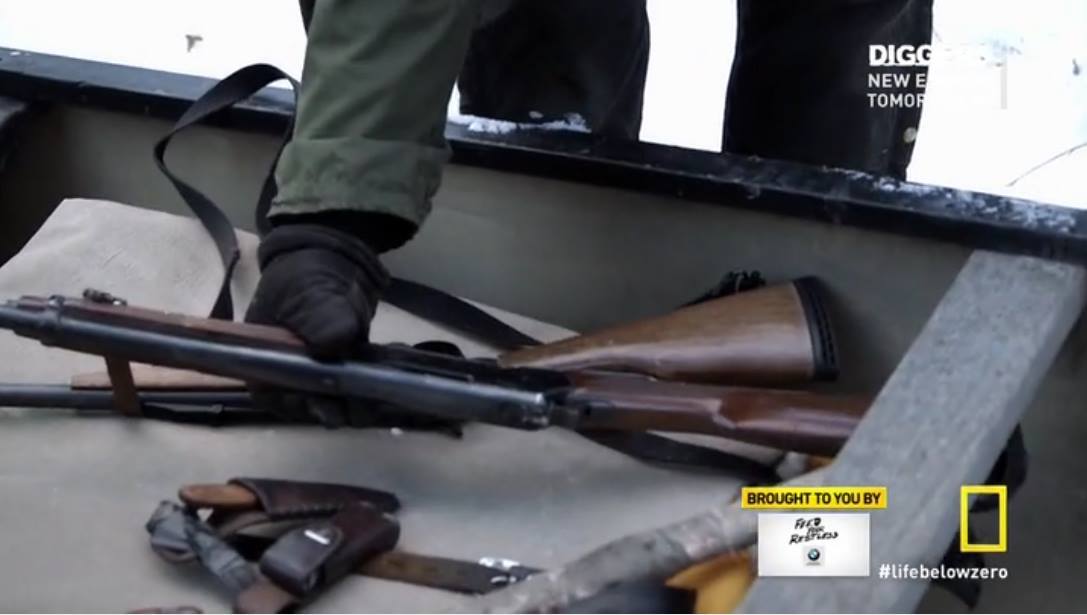
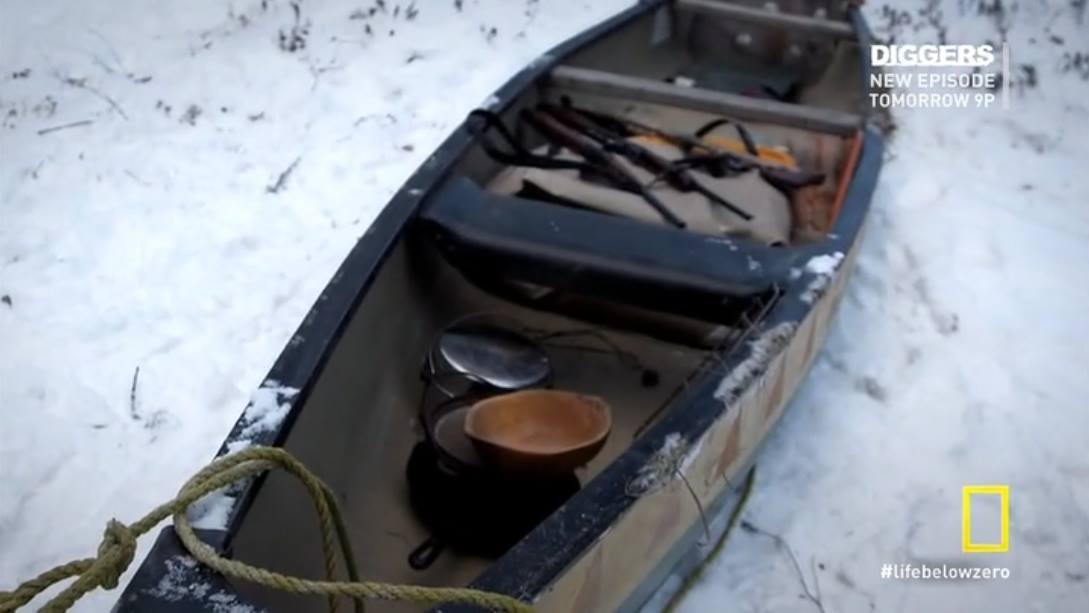
“With these tools (the contents of the canoe, and including the canoe) you pretty much have everything you need to live [in the Alaskan interior on the Yukon].”

"I moved out here when I was 22 years old. I didn’t know shit when I got here… but something in my heart just told me I had to come up here to Alaska and check it out. "

“…so basically what I had was a high powered rifle; I had a .22 rifle… I had a small Hudson Bay axe” – Andy Bassich, Life Below Zero

What’s not so easy to see is, as @glennh originally mentioned:

*Canvas Wall Tent, and actually one from the company linked originally

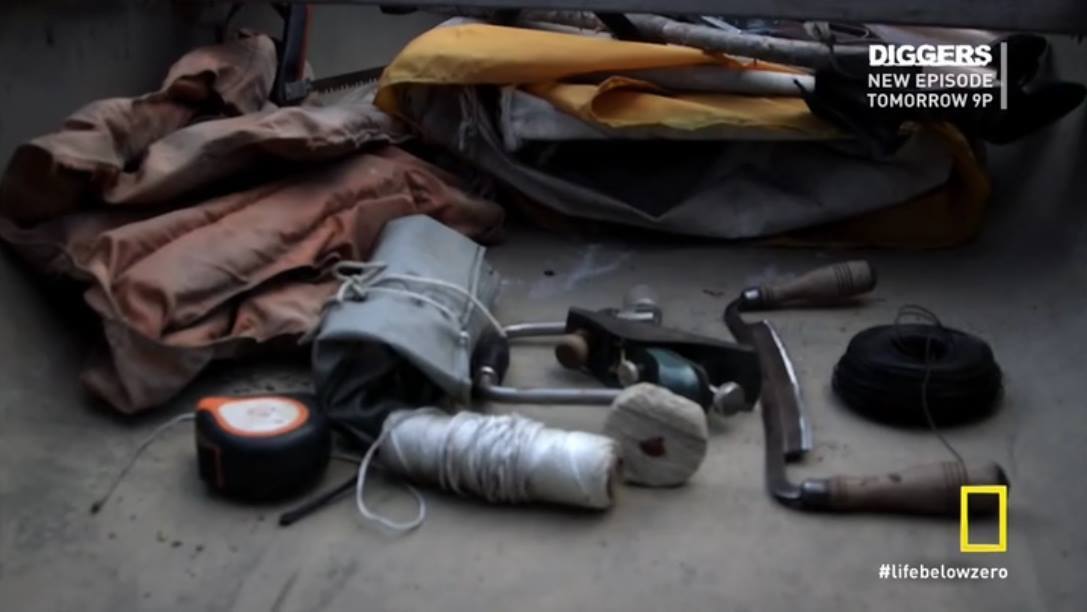
And the more obvious things pictured that have more or less been mentioned above:

  • Bow saw
  • Draw knife
  • Brace
  • Block planer
  • Bowl (birch, so it doesn’t freeze to your face like metal)
  • Cooking equipment
  • Axe (Hudson Bay version in this case)
  • Misc. knives
  • Cordage

In other words, nothing new, but more confirmation from folks who have gone from lower 48 life to a more or less Alaskan subsistence lifestyle.

A book showing how to weave the babiche. Does Snow Walker’s Companion have this info? Or sit down with someone that knows such things. I don’t see a pair of Mukluks on the list, such a boot will also easily fit into the Altai Hok ski binding.

Thanks for all the info. Little overwhelming, but gives me a start.

So, let’s see. I need to make a tent, anorak, snowshoes, canoe/kayak…shit that’s a lot. I have the sleeping pads down: I make braintan sheep hides and I have a bunch. The other stuff on the list is going to take a while to get. Minnesota is kind of Alaska Jr., so a lot of this stuff is easily available around here.

I met Kilii of Seawolf (and a bunch of his students and their finished kayaks) randomly in Seattle one night. The kayaks are definitely nice. Here’s a greenland kayak build-a-long online.

I get making stuff in Alaska, but since I have my own place right now I’m going to make them here. I have access to all the lumber, tools, and space I need. I don’t think I would make a kayak here though.

Instead of snowshoes I think I might make these Siberian Hanti skis. Marcus Lepola says, “I have been planning to make a pair of snowshoes but I realized that I could instead replicate the next best thing; - a simple pair of Siberian skis.”

After being here a winter, one of the things I’d do differently is skip the skis and focus on snowshoes. The Hok’s didn’t work so great for me (just sank unless on a trail pre-packed by snow machine), and @david broke bindings on a pair he was trying. If I had a dog or two, skijoring (sp?) would probably change my mind, but I think there’s good reason various Alaskan peoples developed snowshoe traditions, and not ski traditions.

My use-case vis a vis snow floatation is more traveling across untracked snow, and I think snowshoes are better suited for that.

Then again, I’m not a skilled skier, so I’m biased by the gap inlearning curves.

I really wouldn’t worry about boats before getting here, unless you save for a packraft. Due to the one-way nature of paddling on rivers, we opted for a 17’ Ally pack canoe. It’s something like 50 lbs packed, and functions pretty well on the water. Non-folding kayaks and canoes seem to have a tendency to get stuck downriver. @glennh has a motor, but @david reiterated to be again the other day something like, “if you’re going to use a motor, just get a boat designed for it. if you’re going to paddle, use a canoe. canoes weren’t designed for motors”. So there’s some difference of opinion on the matter.

@andrew, if you could do it again would you sew or buy a tent? And would you get fire-retardant canvas, or just get something like the Alaska Tent “natural” canvas that @glennh recommends? Alaska Tent and Tarp won’t put a stove jack in the canvas. Do people just do this anyway?

I place more weight in your personal experience, and yet I have to think people of Siberia (and Finland) had similar snow (dry powder?) as in Alaska. Seems like Marcus Lepola is using them to travel by shuffling through powder. I’m not a super experienced skier, alpine or nordic style. But skiing is super fun. I imagine skiing down a hill is more fun than walking down in snowshoes. Going up, maybe not as fun (though the moose fur/seal fur would help with that).

Tents/canvas

As per my mistakes, the input of @david and @jeffyacevich, and Snow Walker’s Companion, get the lightest canvas you can find.

That means:

  • as untreated as possible (understanding extra care will be required to prevent mildew)
  • as close to 4 oz. as you can find. it appears 6-6.5 oz. is available in all natural if you search for it. David and Jeff just got some, and I’ll inquire about sources. most manufacturers (Alaska Tent & Tarp, etc.) use something like 10 oz. that ends up being 13 oz. if it’s treated for mold and mildew.
  • @glennh and I had a lengthy and productive conversation about canvas on Facebook, and I will try to get that transferred over (minor pain on a tiny phone). my takeaway from that conversation was, if money is no object, Ventile® (imported from the UK) and a Swiss (?) brand that’s a licensee, is the best canvas that can be purchased currently. it’s in the 4-4.25 oz range, and apparently fantastically magical stuff. I suspect a group purchase could be made, and I plan to look into this for myself either way.

So… would I build or buy? @jenniferocious and I built a basecamp tent, which was something like 10’x15’ before seam allowance, and has 5’ vertical walls. Manufacturing it on a home machine was a very frustrating endeavor, and we never would have finished it had we not gotten access to a huge open room at a school to spread it out and complete it. Generally speaking, I would not like to build another wall tent again.

That said, it is very difficult to find a wall tent manufacturer that uses light enough canvas, which basically means you have to build your own, or have something unnecessarily heavy. It is very likely that I will build at least one more wall tent in my lifetime. The 2nd attempt should be less frustrating as it would be dimensions something like 9’x7’ with 3’ walls (I created a spreadsheet that allows inputting various dimentions and it spits out the canvas yardage I can probably share somehow). I don’t really like the idea of a wall tent for a basecamp long-term as it requires a lot more firewood (thank you, Captain Obvious). My next wall tent(s) will likely be travel sized, and therefore a more manageable process.

1 Like

Stove Jacks

Installing them is preferable anyway (if they're pre-installed permanently, they always seem to be in the wrong spot for folding). The consensus *best* way seems to be to build a fabric "frame" that's open on the top which allows a sheet metal (or what have you) stove jack to slide in. I don't know how to explain that well in words.

In Fairbainks, I rolled into the transfer station (aka dump) and picked out a piece of free sheet metal in less than 5 minutes. Tin snips. Slightly sore hands. Done.

{from facebook}

looks like EtaProof/Ventile (brand names) may be the answer.

"EtaProof is exactly the same as Ventile - the fabric was invented in the UK, and originally produced in the UK but eventually production was shipped overseas to Switzerland and is now produced by EtaProof. The Ventile brand-name still exists, and actually I think the majority of EtaProof’s sales is through the ventile brand name in the UK.

They offer a variety of weights, and each has its advantages. Strangely, you tend to find that the thinner the fabric the more water-resistant it is (which is great for you gram counters). Unlike most fabrics, it is completely breathable when dry, but when wet the cotton fibres swell to fill the tiny voids between the warp and weft to make it waterproof - essentially, it reacts to the natural environment.

It’s used today for all sorts of applications. The British Antarctic Survey use it for Antarctic tents (it performs incredibly well in snow/cold environments, but it’s used by NATO fighter pilots for their flight suits (to protect against cold water if they crash, but the breathability also allows the pressure inside the suit to stabilise during fast ascents / descents)."

http://www.backpackinglight.com/cgi-bin/backpackinglight/forums/thread_display.html?forum_thread_id=86676

older thread on Ventile

http://www.myccr.com/phpbbforum/viewtopic.php?f=36&t=17991

“Ventile is not often used in the United States, but in Europe, especially in the UK, it has had a revival with the bushcraft movement. It is popular with birdwatchers and naturalists because, unlike synthetic fabrics such as Gore-Tex, it is quiet in use. It is used by survivalists and bushcrafters in the European forests because of its good resistance to tearing and burning. It is also widely used in polar expeditions. Lighter-weight artificial fibers are the preference among mountaineers. A Swiss implementation of the same technology is sold under the name EtaProof. Among companies producing Ventile clothing are the Scottish clothing company HillTrek, Snowsled of Gloucestershire and Snugpak of West Yorkshire in England, and Wiggy’s of Grand Junction, Colorado, USA.”

one of the discussions mentioned a 10 yd minimum from the manufacturer

UK

http://www.ventile.co.uk/

Switzerland

http://www.stotzfabrics.ch/outdoorstoffe/outdoorstoffe_en.html

the strong dollar might make the numbers work.

I looked hard at getting a set of Hok’s last winter but stuck with my old pair of telemark skies, not that I do much down hilling, mostly cross country, I like the metal edges mostly. I’m curious how the binding broke? cold temps? poor workmanship? I know they come in two lengths, I would for sure look at the longer ski. I grew up skiing cross country and your ability on skis really makes or breaks how comfortable you are on them. For quick getting around with a light pack skis are great. Pulling a sled and weight, snowshoes would be the way to go, stash the skis on the sled.

What about Egyptian Cotton if this Ventile stuff is too hard to get? I actually saw someone at Traditional Ways with a large Egyptian Cotton tent. He was planning on using it while hanging out with the Cree in winter conditions. http://tentsmiths.com/egyptian-cotton-tents.html

Snow Walker’s Companion (?, i keep forgetting the title) refers to it as “balloon silk”, which is supposedly the same as egyptian cotton. I think the thing there is just that “egyptian cotton” by itself doesn’t tell you much about it. I believe that Tentsmith link has been showing the fabric as out of stock for a number of years now, though that’s not a clear memory.

From a private message response to the earlier Facebook thread:

“Hey- saw the post about you or Glenn looking for lightweight high quality cotton fabrics. I’m constructing a tent [and] i purchased ventile after a LOT of research for the inner tent fabric. I got samples and did all sorts of stuff to them to see how well they worked. Dealing with customs was a bit of a chore but I’m confident the investment will be worth it…”

Ventile is $46.62/yd! That’s expensive. That’s from here: http://www.pennineoutdoor.co.uk/P80-ventile-lighweight%20breathable%20and%20water%20resistant?filter_name=ventile

Here’s my math. I may have done it incorrectly. They have it at 27.50 in english pounds per meter. 27.50 x 1.55 (1 pound to 1.55 u.s. dollars) = $42.625 per meter; 42.625 x 1.09 (1 m = 1.09 yd) = 46.62